
For Immediate Release
Eau Claire Redevelopment Authority Moves Forward with Riverwalk District Feasibility Study
EAU CLAIRE, Wis. – The City of Eau Claire Redevelopment Authority (RDA) has authorized staff to begin the Request for Proposals (RFP) process to hire a consultant for a feasibility study exploring the potential for a riverwalk district along the Chippewa River.
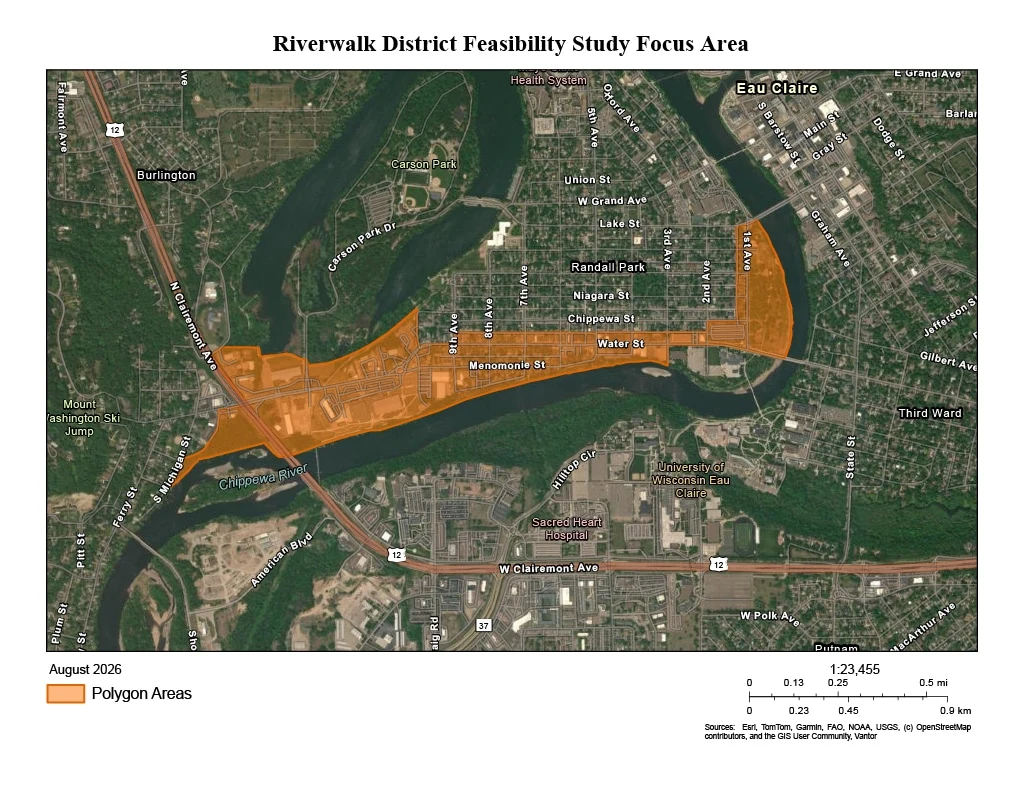
The study will focus on the river corridor extending from the Lake Street and First Avenue area through the Water Street Business Improvement District and west toward Clairemont Avenue. Identified as a focus area within the recently adopted Core Reinvestment District Redevelopment Plan, the corridor includes a mix of neighborhoods, businesses, recreational destinations, institutional uses, redevelopment opportunities, and existing connections to the Chippewa River.
The RDA’s action does not approve a riverwalk project, route, design, or construction plan. Instead, it allows the City to seek a qualified consultant to determine whether a riverwalk district is feasible and, if so, what it could realistically look like.
Studying the Opportunity Before Making Decisions
The feasibility study is intended to answer fundamental questions about the corridor before the RDA considers more detailed design or implementation work.
The selected consultant will evaluate existing land uses and property ownership, environmental and shoreline conditions, infrastructure and utilities, transportation and trail connections, market conditions, regulatory requirements, potential costs, and opportunities for redevelopment and public access.
The study will also explore how a potential riverwalk could connect surrounding neighborhoods, businesses, parks, trails, streets, and community destinations; what types of commercial, recreational, cultural, or public uses could realistically be supported; and whether improvements could be implemented incrementally over time.
“This is about doing the homework before making decisions,” says Aaron White, Community Development Director for the City of Eau Claire. “There’s a lot of activity already happening along this stretch of the Chippewa River, but there are also physical, environmental, property, and financial questions that need to be understood before there’s more development. The feasibility study will give the Redevelopment Authority, surrounding neighborhoods, property owners, businesses, and the broader community an opportunity to look at those questions together and determine what’s possible.”
Community Input Built Into the Study
Community and stakeholder engagement will be incorporated throughout the feasibility study rather than occurring only after recommendations have been developed.
Early in the process, the consultant will identify and engage nearby residents, neighborhood representatives, property owners, businesses, recreational users, civic organizations, tourism organizations, environmental and watershed partners, developers, utilities, and other public agencies.
Engagement may include neighborhood meetings, stakeholder interviews, small-group discussions, public workshops, surveys, online feedback opportunities, and other methods recommended by the consultant. Input gathered early in the process will help document how people currently use and experience the corridor, identify opportunities and concerns, and inform the development of potential concepts.
Later in the study, conceptual alternatives will be brought back to residents and stakeholders for additional feedback before a preferred direction is identified. The final report will document what was heard, how community input influenced the recommendations, and where technical, environmental, regulatory, financial, or property constraints affected the outcome.
“We want people who live, work, own property, operate businesses, and spend time along this corridor involved while ideas are still being developed,” White continues. “The purpose of engagement isn’t necessarily to present the community with a finished plan though. It’s to make sure local knowledge, priorities, and concerns are part of the feasibility work as potential options are evaluated.”
From Feasibility to a Long-Term Plan
The study is expected to proceed through six phases:
- Project kick-off and stakeholder engagement
- Existing conditions assessment
- Market and economic analysis
- Concept plan development
- Regulatory, environmental and implementation review
- A final report and presentation to the Redevelopment Authority
Among the study’s central questions will be how riverfront improvements and future private redevelopment could reinforce one another. The consultant will also examine opportunities to improve public access and connectivity while recognizing existing private property, environmental constraints, neighborhood compatibility, and the likelihood that any future riverwalk would need to develop incrementally over many years.
At the conclusion of the study, the RDA will receive recommendations about whether and how the concept could move forward. Those recommendations could identify additional engineering or environmental studies, future public engagement, funding opportunities, property or easement discussions, redevelopment activities, partnerships, or detailed design work that would be necessary before any improvements could be implemented.
Next Steps
With RDA authorization, City staff will prepare and issue an RFP based on the approved scope of work. Consultant proposals will then be evaluated before a firm is selected to complete the feasibility study.
Additional information about the study, opportunities for community participation, meeting materials, maps, and project updates will be shared as the process moves forward.
For media inquiries or more information, please contact:
Kendall Williams
Economic Development Division
City of Eau Claire
(715) 839-4914
kendall.williams@eauclairewi.gov
About the City of Eau Claire
The City of Eau Claire, located in west-central Wisconsin, is committed to fostering a thriving economic environment that supports businesses of all sizes, promotes job growth, and enhances the quality of life for its residents.