
Eau Claire, Wisconsin’s economy has never stood still for long.
Over nearly two centuries, the community has grown from a river-based center of trade and lumber production into a regional hub for modern industries from manufacturing, healthcare, and education to retail, technology, and the arts.
That transformation hasn’t followed a straight or easy path, however. Eau Claire has faced depleted forests, changing transportation systems, factory closures, healthcare disruptions, recessions, labor shortages, and major shifts in technology. Each era has brought new opportunities, but it’s also pushed the community to ask an important question: “What comes next?”
Looking back over its evolution, the defining theme of Eau Claire’s economic history isn’t any one industry—it’s reinvention. Again and again, from the early 1800s to present day, community members have taken the infrastructure, skills, institutions, and places created during one economic era and used them to build the next, giving Eau Claire its reputation as one of Wisconsin’s top-ranked cities.
Long before there was a city at the meeting point of the Eau Claire and Chippewa rivers, Indigenous communities lived, traveled, harvested, and traded throughout the region. The rivers provided food, plants, building materials, and transportation routes that connected communities across what’s now western Wisconsin and eastern Minnesota, specifically to the Ojibwe and Dakota peoples, who both have deep historical connections to this area. Their tribes have lived along the river systems of the Chippewa Valley for thousands of years, relying on the waterways for food, materials, travel, and trade.
Beginning in the late 1600s, European and Métis fur traders entered their existing networks. Fur trade connected the region to markets across the Great Lakes, Canada, the Mississippi River system, and eventually Europe. It depended heavily on the knowledge, labor, relationships, and assistance of Indigenous people.
During the 1800s, treaties transferred large areas of Indigenous land to the United States, but Ojibwe leaders retained rights to hunt, fish, and gather within portions of the ceded territory. Those treaty-reserved rights are still active today and are exercised and managed by sovereign tribal nations.
This early history points to one of the most important facts about Eau Claire’s economy: the rivers were the region’s original infrastructure. They shaped where people traveled, exchanged goods, gathered resources, and eventually built settlements and industries.
Permanent Euro-American settlement around the confluence began to grow quickly during the 1840s. Eau Claire’s location offered almost everything a lumber operation needed: vast pine forests stood upstream, rivers could carry logs to the mills, and finished lumber could be shipped toward growing markets. The Chippewa River also connected Eau Claire to the Mississippi River and communities throughout the Midwest, making trade to other parts of the country possible.
Sawmills also began operating near the confluence during the 1840s. Several separate settlements formed around the mills and river crossings before coming together as the City of Eau Claire in 1872, and by the late 1800s, Eau Claire had become one of the region’s leading lumber centers.
For roughly half a century, lumber was the industry around which much of the community grew. Workers cut timber throughout the Chippewa Valley during the winter. When spring arrived, logs were moved into streams and rivers and floated downstream to Eau Claire. The city’s mills then turned them into boards, shingles, lath, boxes, doors, windows, and other materials used to build farms, railroads, factories, homes, and cities. The scale of the industry was enormous. Between 1883 and 1903, the Northwestern Lumber Company alone produced an average of about 38 million board feet of lumber each year.
And lumber supported far more than lumberjacks and sawmill workers. It created jobs for teamsters, river workers, machinists, blacksmiths, carpenters, builders, railroad employees, merchants, hotel operators, bankers, and many others. The wealth created by the industry also helped pay for homes, commercial buildings, transportation systems, and civic institutions.
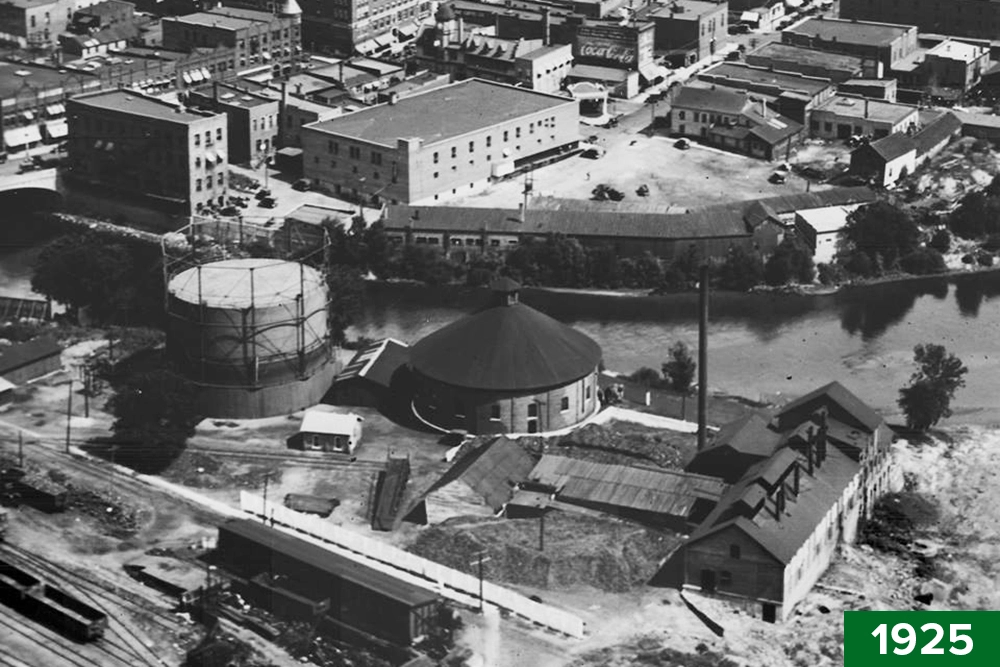
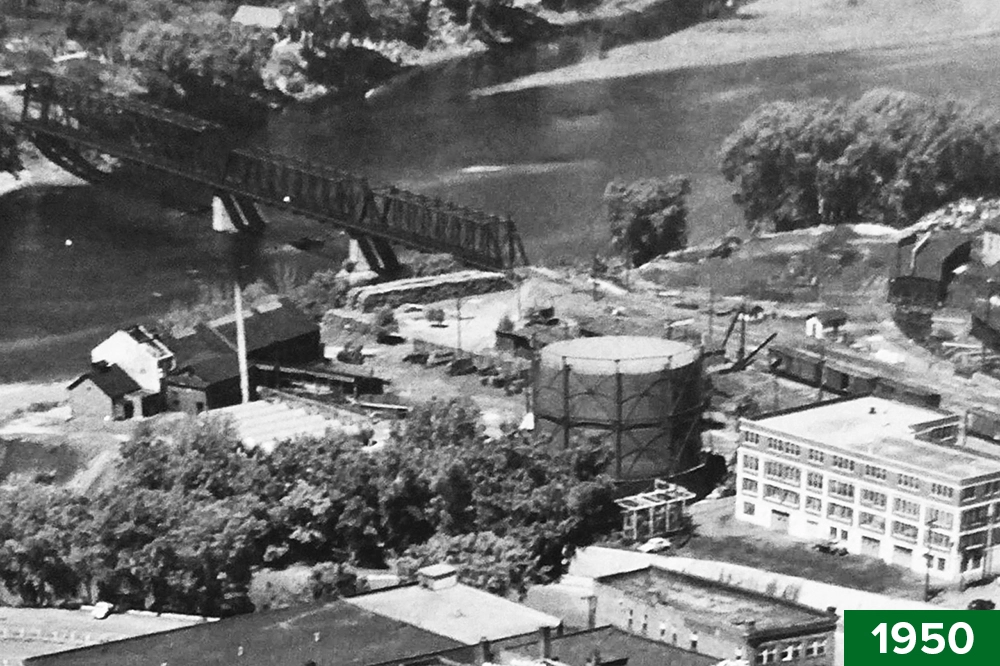
Lumber shaped the physical city, too. Mills, warehouses, foundries, rail sidings, and lumberyards once lined the rivers and Half Moon Lake, and many of the places residents now know as parks, trails, housing, offices, and downtown destinations were once part of the busy industrial landscape.
The rivers made Eau Claire’s lumber economy possible, but the railroad helped it reach an even larger market.
The first train arrived in Eau Claire in 1870, two years before the city was incorporated. That connection gave local businesses a faster and more reliable way to move goods to communities that were difficult—or sometimes impossible—to reach efficiently by river. For lumber companies, rail service meant they didn’t have to depend as heavily on seasonal river conditions because finished lumber could now be shipped throughout the year, helping Eau Claire’s mills serve customers across the Midwest and beyond.
The trains also brought important resources into the city. Machinery, fuel, building materials, consumer goods, workers, and investment all moved more easily through Eau Claire once it was connected to the growing national rail network.
As time went on, the railroads eventually carried far more than lumber. Agricultural products, manufactured goods, food, livestock, construction materials, and other commodities moved into and out of the city. Warehouses, wholesalers, retailers, and service businesses grew around that activity, creating jobs and strengthening Eau Claire’s role as a regional marketplace.
Once known as merely a place where timber was processed, Eau Claire was quickly becoming a transportation and commercial center for farms, businesses, and smaller communities throughout western Wisconsin thanks to its railways. That broader role became especially important as the pine supply began to decline. The railroad had helped lumber grow, but it also gave Eau Claire the connections it would need to support new industries once the lumber era came to an end.
Eau Claire didn’t wait until the last sawmill closed to begin building what would come next. In fact, the skills that helped support the lumber industry were already laying the groundwork for a much broader manufacturing economy. Sawmills needed boilers, engines, saws, conveyors, metal parts, repair shops, and specialized logging equipment. Local machinists, foundries, and equipment companies grew to meet that demand.
At first, many of those businesses served the lumber industry directly. But over time, they built skills and production capabilities that could be used to make other products, too.
Phoenix Manufacturing Company became one of the clearest examples. Its predecessors began operating in the 1860s, and the company later earned a national reputation for sawmill and logging machinery. It became especially well known for the Phoenix log hauler, a steam-powered machine designed to move heavy loads through winter logging camps.
This shift became one of the most important turning points in Eau Claire’s economic history.
Beyond empty mills and cleared forests, the lumber era also left behind industrial land, railroad connections, machine shops, skilled tradespeople, mechanical knowledge, investment capital, supplier networks, and a workforce that already understood large-scale production as the pine supply declined. Those assets gave Eau Claire a strong foundation for industries that didn’t depend on local timber.
National Presto Industries, founded in Eau Claire in 1905, became one of the community’s most recognizable manufacturers. The company originally produced industrial equipment, including gas engines and machinery used for railroad construction and repair, bur later became nationally known for pressure cookers, housewares, and small electric appliances.
Other companies followed similar paths, producing tires, rubber products, machinery, metal goods, food products, household items, and electrical components. Instead of relying on one natural resource, Eau Claire was beginning to make a much wider range of products for regional and national markets. Eventually, manufacturing replaced lumber as a major source of industrial employment, growing out of the equipment, skills, infrastructure, and business relationships the lumber economy had already created.
In many ways, this was Eau Claire’s first major economic reinvention, which began before the lumber era was even over.
While manufacturing was growing, Eau Claire was also building institutions that would become just as important to the local economy.
Luther Hospital opened in 1908 after being founded by a group of Norwegian Lutheran clergy. During its first year, its staff treated 195 patients and continued to expand as the region grew, eventually becoming a major medical center that served patients from across western Wisconsin and is now part of Mayo Clinic Health System.
Eau Claire’s vocational and technical education system was also taking shape during this period. The institution that eventually became Chippewa Valley Technical College grew alongside the needs of local employers, preparing students for careers in the trades, manufacturing, healthcare, business, and new technologies.
Then, in 1916, the Eau Claire State Normal School opened with 159 students and 20 faculty members. Its original mission was to train teachers, but the school gradually expanded its programs and role in the community—eventually becoming the University of Wisconsin–Eau Claire.
Healthcare and education changed Eau Claire’s economy in lasting ways. They created stable professional jobs, trained workers for local employers, attracted students and families, supported research and specialized services, and brought people and spending into the community from across the region. Plus, they helped Eau Claire become more than an industrial city.
People increasingly traveled here for medical care, education, job training, shopping, banking, government services, entertainment, and other needs. These two industries turned Eau Claire into the service center for a much larger part of western Wisconsin—a role the city still plays today.
One company came to represent Eau Claire’s 20th-century manufacturing economy more than almost any other. The Gillette Safety Tire Company was founded in Eau Claire in 1916, and its operation grew quickly—producing tires, inner tubes, rubber products, and machinery used in rubber manufacturing.
The United States Rubber Company took control of Gillette in 1940, and the plant later became part of Uniroyal. During World War II, the facility shifted to ammunition production to support the war effort before returning to tires and other rubber products.
For generations, the plant provided thousands of local residents with steady industrial jobs. Many families had more than one generation work there, making the plant an important part of both Eau Claire’s economy and its identity, with an impact that reached well beyond the factory itself. The plant supported transportation companies, suppliers, contractors, restaurants, shops, housing, and other local businesses. The wages earned there then circulated throughout the community, helping support everything from neighborhood stores to home construction.
The plant reflected many of the strengths Eau Claire had developed after the lumber era: industrial experience, railroad and highway access, a skilled workforce, and the ability to manufacture products for national markets. But it also revealed a risk Eau Claire had faced before… When one employer becomes a major part of a community’s economy, decisions made by corporate leaders or changes in national and global markets can have enormous local consequences.
For much of the 20th century, the tire plant stood as a symbol of Eau Claire’s manufacturing strength, and its eventual closure would become one of the greatest economic tests in the city’s modern history.
After World War II, manufacturing remained central to Eau Claire’s economy, but it was no longer the only major source of growth.
Uniroyal, National Presto, and other manufacturers continued to provide thousands of industrial jobs. At the same time, hospitals and clinics expanded, UW–Eau Claire grew from a teachers college into a comprehensive university, and Chippewa Valley Technical College added new programs as technology and employer needs changed.
Other parts of the economy were growing too. Banks, government offices, construction companies, professional services, restaurants, hotels, and retailers all became more important sources of jobs and investment.
The way people moved through the community was also changing. As automobile ownership increased and new highways were built, residential and commercial development spread beyond the historic downtown. Businesses followed new neighborhoods and traffic patterns, creating shopping areas along major roads and on the city’s south side.
Oakwood Mall opened in 1986 and helped strengthen Eau Claire’s role as a shopping destination for western Wisconsin. Residents from surrounding communities increasingly traveled to the city not only for work, healthcare, and education, but also for shopping, dining, and entertainment.
One of Eau Claire’s most successful homegrown companies also began during this period. Menards was founded in Eau Claire in 1960 and grew from a local construction business into a national home-improvement retailer. Even as the company expanded across the Midwest, it kept major corporate and distribution operations in the Eau Claire area.
By the end of the 20th century, the local economy looked very different from the one built around lumber or even the one dominated by large factories. Manufacturing was still important, but it now existed alongside healthcare, higher education, retail, finance, government, construction, hospitality, and business services.
That growing diversity made Eau Claire more resilient, but in 1991, the community would face a major test.
In 1991, Uniroyal announced that its Eau Claire tire plant would close, affecting approximately 1,300 jobs and more than $40 million in annual payroll. At the time, those jobs represented a significant share of the manufacturing employment in Eau Claire and neighboring Chippewa County.
For workers and their families, the closure meant much more than a number in an economic report too. People lost wages, health benefits, retirement security, daily routines, and long-standing friendships. Some families had worked at the plant for generations, so the closure also marked the end of a shared history and way of life.
Eau Claire couldn’t quickly or completely replace what was lost either. Many displaced employees needed new training before they could move into different careers. Some found jobs that paid less or offered fewer benefits, while others retired earlier than planned, relocated altogether, or transferred to another Uniroyal facility.
Still, the community’s response became an important example of how Eau Claire could adapt during a major economic crisis.
Chippewa Valley Technical College helped provide retraining for former employees. Worker-assistance programs connected people with benefits, counseling, education, and job opportunities. The City also created financing tools designed to support job creation, business expansion, and entrepreneurship, resulting in a surge of new startups.
The plant itself, however, presented another enormous challenge. At approximately 1.9 million square feet, it was far too large to leave vacant and difficult for any single new company to occupy. Instead, the property was purchased and transformed into Banbury Place, a multi-tenant business and industrial complex. Rather than waiting for one employer to replace Uniroyal, the building was divided into spaces that could support many different businesses, and within about six months, roughly half of the property had already been leased.
American Phoenix also reused equipment from the tire operation to establish a rubber-processing business, preserving part of the site’s manufacturing history while creating a new company and new jobs. Five years after the plant closed, businesses operating at Banbury Place employed approximately 850 people—about two-thirds of the number lost at Uniroyal.
That recovery didn’t erase the hardship of the closure, and the new jobs weren’t always equal to the ones they replaced. But it showed that existing buildings, infrastructure, workforce skills, entrepreneurship, and coordinated local action could keep a massive industrial property from becoming a long-term economic liability.
The experience also left Eau Claire with lessons that still matter today:
The Uniroyal closure was one of the most difficult moments in Eau Claire’s modern economic history. It also showed that the community could respond to major change by reusing what it already had and creating room for something new.
Eau Claire’s riverfront tells the story of the city’s next economic transformation in a very visible way.
For much of the 19th and 20th centuries, the land around the confluence of the Chippewa and Eau Claire Rivers was heavily industrial. Mills, foundries, rail lines, warehouses, utilities, and other businesses lined the rivers. These uses originally helped build Eau Claire’s economy, but when many of them closed or moved, they left behind vacant buildings, contaminated land, outdated infrastructure, and riverfront areas that were largely cut off from public use.
The site that eventually became Phoenix Park was one of the clearest examples. For more than a century, the property had been used for lumber, steel production, railroad activity, and other industrial purposes, so preparing it for a new use wasn’t simple. The City and the Redevelopment Authority worked with state and federal partners for several years to assess the site, clean up contamination, acquire property, and plan for redevelopment.
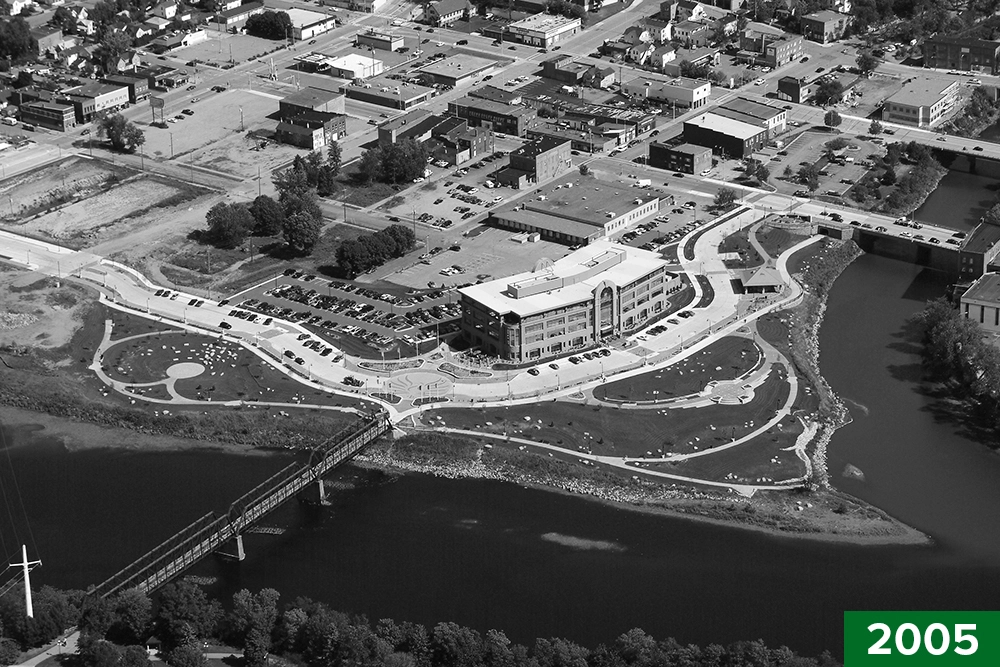
Finally, after nearly twenty years of planning, Phoenix Park opened in 2005 as the first major public investment in the North Barstow Redevelopment Area.
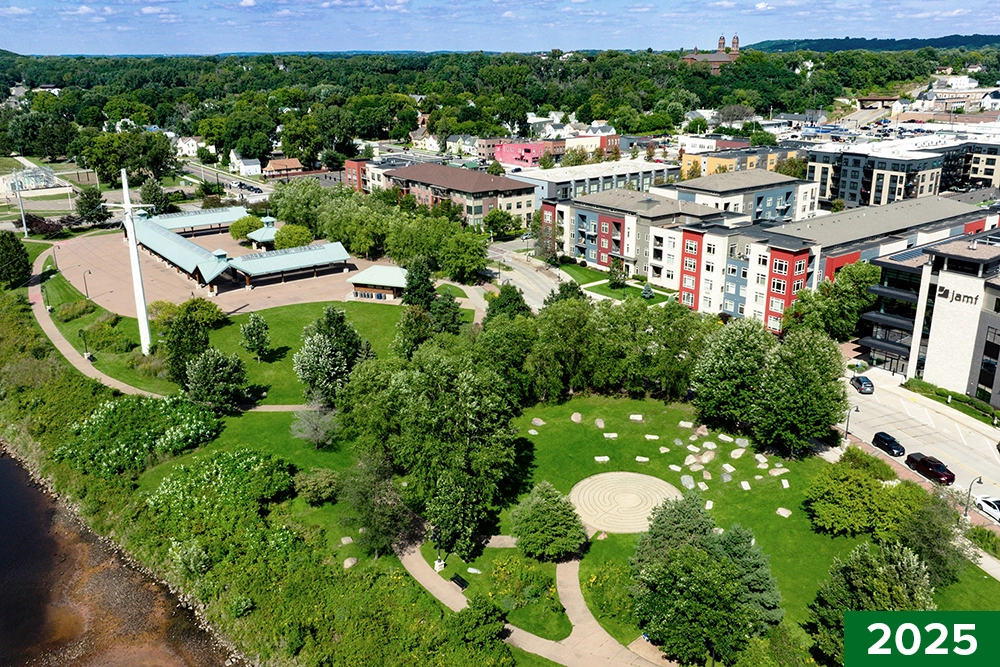
The redevelopment immediately changed how people experienced the riverfront and helped residents, businesses, and developers see new possibilities for the area. The park, Farmers Market pavilion, trails, public spaces, river access, and environmental improvements created a place where people wanted to spend time. Those investments also helped attract housing, restaurants, shops, offices, and other private development.
Over time, the district became home to Royal Credit Union’s corporate headquarters, Jamf’s downtown campus, the Riverfront Terrace neighborhood, the Children’s Museum of Eau Claire, Menomonie Market Food Co-op, and other businesses and developments.
This marked a different kind of economic development for Eau Claire. For the first time, the community was focused on investing in quality of place—parks, walkability, housing, recreation, river access, culture, and public spaces that could attract residents, workers, visitors, and businesses—instead of just factories and industrial production. In many ways, the riverfront’s redevelopment also brought Eau Claire’s economic story full circle. The same rivers that once powered trade and industry were becoming the center of a new kind of growth.
As Eau Claire entered the 21st century, technology, knowledge, and entrepreneurship became increasingly important parts of the local economy. Faster internet connections and new digital tools made it easier for companies in software, consulting, design, finance, and other professional fields to reach customers far beyond western Wisconsin.
Jamf, founded in Eau Claire in 2002, quickly became one of the city’s highest-growth ventures. The company grew from a local startup into an international software business specializing in the management of Apple devices. Its success showed that a technology company didn’t have to be located in a major metropolitan area to compete globally. It also demonstrated that Eau Claire could support businesses built around software, innovation, and specialized knowledge—not just physical products.
UW–Eau Claire and Chippewa Valley Technical College helped support that shift by preparing graduates for careers in technology, business, communications, design, and other professional fields.
Entrepreneurship was growing across the economy, too. Local residents opened restaurants, breweries, shops, service companies, and creative businesses, while downtown redevelopment created more space for those ventures. Older and underused buildings found new purposes as offices, apartments, shops, restaurants, studios, and event venues. Properties like Banbury Place also gave smaller companies and startups room to grow without building entirely new facilities.
Eau Claire was still a center for manufacturing, healthcare, education, and retail, but it was also becoming a place where businesses could grow around ideas, expertise, and technology.
As downtown was revitalized, the arts became a major facet of Eau Claire’s story.
Eau Claire native Justin Vernon brought international attention to the region through Bon Iver, the band he formed in nearby Fall Creek. In 2012, Bon Iver won Grammy Awards for Best New Artist and Best Alternative Music Album, introducing audiences around the world not only to the band’s music, but also to its strong connection to western Wisconsin.
Vernon remained closely involved in the community as his career grew. In 2015, he and Aaron Dessner of The National launched the Eaux Claires Music & Arts Festival in Eau Claire. The inaugural festival drew about 22,000 people and brought nationally and internationally known performers to the Chippewa Valley. Its collaborative performances, visual art, and unconventional programming helped put Eau Claire on the national map as an indie music and creative destination.
Blue Ox Music Festival also held its first event in Eau Claire in 2015. Focused on bluegrass, roots, and Americana music, the independently operated festival developed its own following and brought another major annual music experience to the community. Together with local venues, concerts, recording activity, and other regional festivals, Eaux Claires and Blue Ox—alongside other regional festivals such as Country Jam, Eau Claire Jazz Festival, Hoofbeat, Rock Fest, and more—helped strengthen Eau Claire’s reputation as a place where musicians and creative projects could grow.
By the mid-2010s, The Confluence Project continued the broader transformation of downtown and the job market.
The construction of the Pablo Center at the Confluence, Eau Claire’s premier arts facility, added performance spaces, galleries, rehearsal rooms, classrooms, and community gathering spaces to downtown. And just outside its doors, private investment into Haymarket Landing brought new housing and commercial activity, while a new public plaza and pedestrian bridge helped strengthen connections among UW–Eau Claire, downtown businesses, arts organizations, residents, and the riverfront.
These projects showed how economic development, education, arts, tourism, and quality of life can support one another. Concerts and theater performances can bring visitors downtown. Those visitors may eat at a restaurant, shop at a local business, or stay overnight. Plus, students and artists add energy to the community, while cultural amenities can help employers attract and retain workers.
None of this creative innovation replaced manufacturing or Eau Claire’s other established industries. Instead, it added new layers to the economy.
Modern Eau Claire depends on people who manufacture products, provide healthcare, teach students, write software, construct buildings, manage finances, operate restaurants, transport goods, perform music, create art, and start new businesses. That mix is now one of the community’s greatest strengths, and it means Eau Claire’s economy isn’t built around one kind of job, one kind of business, or one way of creating value.
A diverse economy is usually more resilient, but that doesn’t mean it’s immune to disruption.
The COVID-19 pandemic created one of the biggest economic shocks in recent history. Businesses faced temporary closures, supply-chain problems, staffing shortages, rising costs, and major changes in how people worked, shopped, traveled, and spent money. Those pressures didn’t disappear when the public-health emergency ended. Throughout the 2020s, employers have continued to deal with labor shortages, inflation, housing constraints, automation, changing consumer habits, and uncertainty in national and global markets.
Then, in 2024, Eau Claire faced another major disruption.
HSHS Sacred Heart Hospital closed on March 22, 2024, along with related Prevea services with locations throughout the Chippewa Valley. The closures affected more than 1,400 jobs across the region and created immediate concerns about healthcare access, emergency services, patients, employees, medical training, and nearby businesses.
The announcement was especially significant because healthcare is often viewed as one of the most stable parts of a regional economy. The closure showed that even long-standing institutions can face sudden financial and organizational changes. Once again, Eau Claire had to rely on many of the same strengths that had helped the community through earlier transitions: workforce partnerships, educational institutions, cooperation among public and private organizations, strong existing employers, and a willingness to rethink how major properties could be used.
The circumstances were different from the end of the lumber era or the Uniroyal closure, but the broader lesson was familiar. Economic change can happen quickly, and communities are better prepared when they’ve built strong relationships, a diverse employment base, and systems that can help workers and businesses adapt.
Sports and recreation had become another major part of Eau Claire’s identity and economy by the mid-2020s.
After decades of investment in its parks, trails, athletic fields, community programs, and outdoor spaces, Eau Claire is now to more than 75 miles of trails that are meticulously maintained by City staff and community partners. They connect neighborhoods, parks, schools, downtown destinations, and the riverfront, while also linking to the Chippewa River State Trail beyond the city. Residents use these trails for transportation, exercise, and recreation throughout the year. And they’ve become part of the community’s appeal to visitors, new residents, and employers looking for places that offer an active lifestyle outside of work.
Major events have helped introduce that experience to a much larger audience too. Each spring, the Eau Claire Marathon brings runners, spectators, volunteers, and supporters into the city for a full weekend of races and activities. Its courses showcase neighborhoods, parks, trails, the university, downtown, and the riverfront, turning the community itself into part of the event, while also supporting hotels, restaurants, retailers, and other local businesses as participants and their families spend time throughout Eau Claire.
Eau Claire has also developed an international reputation for a much less conventional sport: kubb. The U.S. National Kubb Championship began here in 2007 with 15 teams and 35 players and has since grown to over 150 teams from 20+ countries. Now named the “Kubb Capital of North America,” Eau Claire’s championship welcomes everyone from first-time players to experienced competitors, giving the city a signature event that’s both nationally recognized and rooted in the community’s welcoming character.
Then there was the opening of The Sonnentag Complex in 2024, which added an entirely new level of indoor sports and event capacity.
The $122 million complex includes the Sonnentag Event Center, the John and Carolyn Sonnentag Fieldhouse, the Center for Health and Wellbeing, and sports-medicine services. The event center alone can accommodate up to 5,000 people, while the 84,000-square-foot fieldhouse includes a 120-yard artificial-turf field that can support athletics, practices, tournaments, camps, and other large activities. The facility gave UW–Eau Claire athletics a modern home while also creating opportunities to attract regional and national tournaments, performances, conventions, and community events.
Just as music and the arts helped introduce new audiences to Eau Claire during the 2000s and 2010s, sports and recreation are giving people more reasons to visit, participate, and return than ever.
Today, Eau Claire serves as the employment, healthcare, education, shopping, government, and cultural center of a much larger regional economy.
The U.S. Census Bureau estimated Eau Claire’s population at 72,465 in 2025, an increase of 4.4 percent from the city’s 2020 population base. About 36.7 percent of residents age 25 and older held a bachelor’s degree or higher, reflecting the important role education and professional employment play in the community.
The Eau Claire metropolitan area had approximately 90,600 nonfarm jobs in June 2026. Its largest broad employment sectors included about:
The metropolitan unemployment rate was approximately 2.6 percent. Those figures are preliminary and not seasonally adjusted, but they show how widely employment is now spread across the economy. That diversity is one of Eau Claire’s biggest strengths.
Manufacturing is still a central part of the community’s identity, but it now operates alongside healthcare, education, retail, finance, technology, logistics, hospitality, government, construction, the arts, and professional services. Manufacturing itself looks very different than it did during the lumber or tire-production eras. Today’s facilities use automation, advanced materials, electronics, digital controls, laboratory processes, precision measurement, and global supply chains. They rely on engineers, technicians, machinists, scientists, software systems, quality specialists, and highly trained tradespeople.
Healthcare and education remain major employers and bring patients, students, families, and professionals into Eau Claire from across the region. Retail, restaurants, hotels, entertainment, and cultural organizations serve both local residents and visitors. Technology and professional-service companies can reach customers far beyond western Wisconsin, while entrepreneurs and small businesses continue to create new products, services, and jobs.
Eau Claire’s economy is no longer defined mainly by what can be taken from the surrounding landscape. It’s increasingly defined by what people know, make, design, test, repair, teach, and create. That shift helps explain where the community may be headed next.
Sources
Indigenous History & Treaty Rights: National Park Service resources on the Dakota, Ojibwe, fur trade, and river systems of western Wisconsin; Great Lakes Indian Fish and Wildlife Commission resources on Ojibwe treaty-reserved hunting, fishing, and gathering rights.
Lumber, Railroads, & Early Manufacturing: Wisconsin Historical Society property and industry records documenting Eau Claire’s lumber companies, first railroad, Phoenix Manufacturing, and industrial development.
Education & Healthcare: UW–Eau Claire Special Collections and Archives; Mayo Clinic Health System; Chippewa Valley Technical College.
Gillette & Uniroyal: UW–Eau Claire Special Collections and Archives records documenting the tire plant from its founding through its 1991 closure.
The Uniroyal Closure & Recovery: Federal Reserve Bank of Minneapolis reporting on worker retraining, Banbury Place, business growth, and job replacement.
Downtown & Riverfront Redevelopment: City of Eau Claire Economic Development Division histories of Phoenix Park, the North Barstow Redevelopment District, and the Confluence Project.
Current Population & Employment: U.S. Census Bureau QuickFacts and U.S. Bureau of Labor Statistics Eau Claire metropolitan-area data.